
This grant program supports internationally focused events held on or near U-M campuses, including cultural activities, conferences, symposia, and other programs designed for U-M students, faculty, and staff. Applications are welcome from U-M units, with a preference for proposals developed in collaboration with students or student organizations. We especially encourage proposals that engage contemporary issues and pilot novel and creative programming. Grants cannot be used for ongoing or recurring events, such as lecture series or annual conferences. They are specifically intended for new programming that meet one or more of the following objectives:
Examples include, but are not limited to:
Individual grants will be up to $10,000. Units will be requested to contribute 25% in cost share. Proposals will be accepted in June 2026—for events taking place in AY 2026-2027. All events supported will be featured on the Global Michigan and Year of Democracy websites and promoted throughout the theme years.
Eligibility Criteria
Grant Guidelines
Application Process
Deadline: Monday, June 1, 2026 at 11:59PM
Please contact Aileen Ash ([email protected]) with any questions.

Apply Now | Deadline June 1, 2026
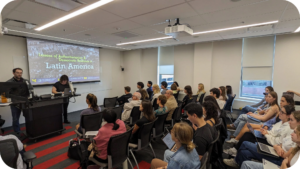 Lessons of Authoritarianism & Democratic Resilience in Latin America, a year-long series, featured four public talks with prominent scholars and activists from across Latin America and one film screening with faculty-led discussion, complemented by workshops for graduate students. Together, these activities advanced U-M’s global engagement mission by connecting campus audiences with regionally grounded expertise on authoritarian governance, resistance movements, memory and human rights education, digital civic spaces, and Indigenous governance.
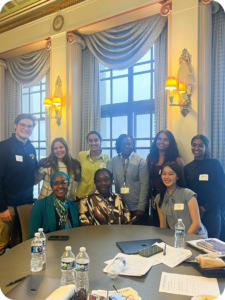 The Sustaining Strong Global Partnerships: A Workshop for Student Organizations was a full day educational event hosted by the Center for Global Health Equity (CGHE), Michigan Health Engineered for All Lives (M-HEAL): The Initiative, and the Global Health Alliance (GHA). The workshop brought together student interested in global health; international global partners; and faculty and staff mentors to explore best practices for equitable, sustainable, and mutually beneficial global relationships that extend beyond any single leadership team. A main objective guiding this event included promoting cultural humility and understanding by creating opportunities for direct dialogue between U-M students and global partners, emphasizing the important of bidirectional respect and learning. We sought to raise awareness of global interconnectedness by helping students recognize the importance of sustained international collaboration and its impact on global and local health outcomes, preparing the next generation of global leaders becoming.
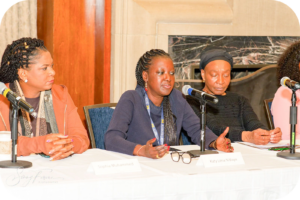 The festival centered on the theme “Voices of Resilience: The Power of Storytelling in African Cinema,” exploring how women filmmakers are redefining narratives and bringing new energy to the film industry. It featured award-winning filmmakers from across the African continent alongside University of Michigan faculty experts for film screenings, Q&A sessions, and panel discussions. Conversations addressed topics such as representation, gender, and the changing landscape of African media, creating space for dialogue among filmmakers, scholars, students, and the broader community.
 The exhibition showcased the 2023 Wallenberg Fellowship project through the materials developed for the project website and the maps that were created by the people of Mexico City. It created the space for students, people of Ann Arbor, and greater Michigan to reflect and share their own relationships with their spaces and water. Prior to the event Student Life Sustainability’s Cultural Organizers hosted Counter Mapping workshops with students on campus during climate week, allowing those maps to be exhibited as well.
 The University of Michigan Department of Nuclear Engineering & Radiological Sciences (NERS) hosted three days of open sessions as part of the OECD NEA Global Forum Symposium on Nuclear Education, Science, Technology, and Policy.The OECD NEA Global Forum is a collaborative platform for strengthening international cooperation on nuclear education, technology development and related policies. The Symposium brought together academic, industry, and policy leaders from around the world to share insights and shape strategies for educating the next generation of nuclear experts.
